
← Back to the Blog
June 9, 2026 · 14 min read
Daniel Igwe
VisitorBoost team
Best Traffic Bot 2026 [Tested & Reviewed]
Traffic bots are tools that generate automated website visits. In the right context, they can help website owners test tracking, check server performance, review geo-targeted experiences, and understand how analytics platforms respond to controlled traffic patterns. In the wrong context, they can quickly become misleading, risky, or counterproductive. That is why the best traffic bot is not simply the one that sends the most visits. It is the one that gives you control, transparency, reliable delivery, understandable reporting, and enough support to use the tool responsibly.
A modern website traffic generator should do more than inflate a pageview counter. It should let you configure where visits come from, how long they stay, which devices they use, which pages they view, and whether they follow a realistic path through your website. The goal is not to chase vanity metrics. The goal is to run controlled traffic campaigns that support testing, benchmarking, and practical marketing experiments on websites you own or have permission to test.
When we reviewed traffic bot services for this comparison, we looked at the full experience rather than a single headline claim. We considered setup speed, interface quality, traffic customization, geo-targeting, reporting, pricing clarity, support availability, and whether the service explains its limitations honestly. We also paid attention to how each provider presents risk. Automated traffic is not a substitute for real customers, real engagement, or a strong organic marketing strategy.
What Makes a Good Traffic Bot?
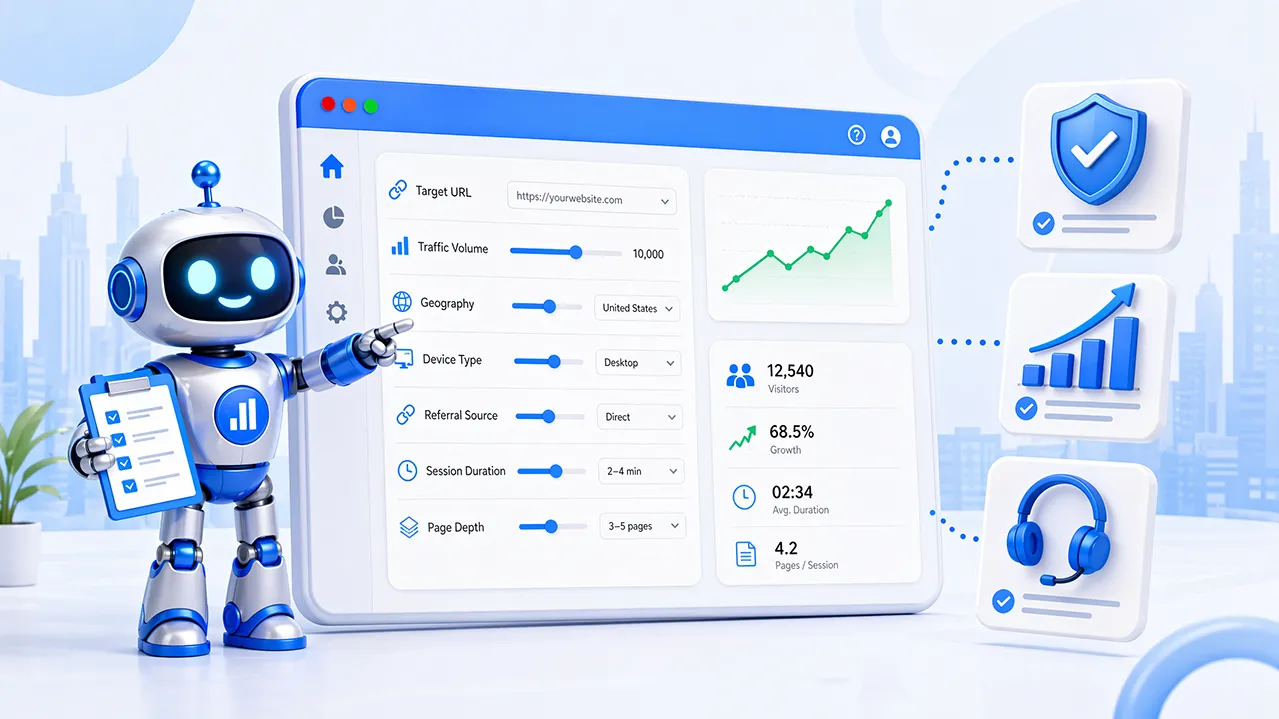
A useful traffic bot should make traffic behavior configurable without making the setup unnecessarily complicated. At a minimum, you should be able to define the target URL, traffic volume, geography, device type, referral source, session duration, and page depth. More advanced platforms may also support keyword-based visits, click paths, bounce-rate control, or API access for resellers and agencies.
Analytics compatibility is another important factor. If you are using a website traffic generator to test dashboards or campaign tracking, you need the generated visits to appear consistently in tools such as Google Analytics or server logs. A service that sends unreliable traffic, repeats obvious patterns, or provides no reporting makes it much harder to understand what you are actually buying.
Ease of use matters as much as technical capability. A good interface should help you create a campaign in a few minutes, explain every setting clearly, and make it easy to pause, edit, or scale delivery. If users need to read long technical documentation just to launch a basic campaign, the product is unlikely to be practical for busy marketers.
Support is also part of the product. Traffic tools can affect analytics, website performance, and client reporting, so customers need a responsive team when something looks wrong. Email-only support, vague documentation, or unclear delivery notifications can turn a low-cost service into an expensive use of time.
Finally, a serious traffic bot should be honest about use cases and limitations. Automated traffic can support testing and controlled visibility experiments, but it does not create genuine demand. It will not replace SEO, conversion optimization, paid acquisition, content quality, or a real audience. Any provider that implies otherwise should be evaluated carefully.
Analytics compatibility is another important factor. If you are using a website traffic generator to test dashboards or campaign tracking, you need the generated visits to appear consistently in tools such as Google Analytics or server logs. A service that sends unreliable traffic, repeats obvious patterns, or provides no reporting makes it much harder to understand what you are actually buying.
Ease of use matters as much as technical capability. A good interface should help you create a campaign in a few minutes, explain every setting clearly, and make it easy to pause, edit, or scale delivery. If users need to read long technical documentation just to launch a basic campaign, the product is unlikely to be practical for busy marketers.
Support is also part of the product. Traffic tools can affect analytics, website performance, and client reporting, so customers need a responsive team when something looks wrong. Email-only support, vague documentation, or unclear delivery notifications can turn a low-cost service into an expensive use of time.
Finally, a serious traffic bot should be honest about use cases and limitations. Automated traffic can support testing and controlled visibility experiments, but it does not create genuine demand. It will not replace SEO, conversion optimization, paid acquisition, content quality, or a real audience. Any provider that implies otherwise should be evaluated carefully.
All the Traffic Bots We Tested
We reviewed several traffic bot and website traffic generator services based on their public positioning, product experience, pricing, feature depth, and support signals. The list below includes VisitorBoost.com, BabylonTraffic.com, TrafficBot.co, Traffic-Bot.com, and EpicTrafficBot.com.
The comparison is not only about who offers the largest number of visits. Some products are cloud-based and subscription-driven, while others are downloadable software that requires more technical setup. Some focus on usability and support, while others emphasize low prices or one-time access. That difference matters because the right choice depends on whether you need a managed service, a self-hosted tool, or a simple low-cost experiment.
The comparison is not only about who offers the largest number of visits. Some products are cloud-based and subscription-driven, while others are downloadable software that requires more technical setup. Some focus on usability and support, while others emphasize low prices or one-time access. That difference matters because the right choice depends on whether you need a managed service, a self-hosted tool, or a simple low-cost experiment.
1. VisitorBoost.com
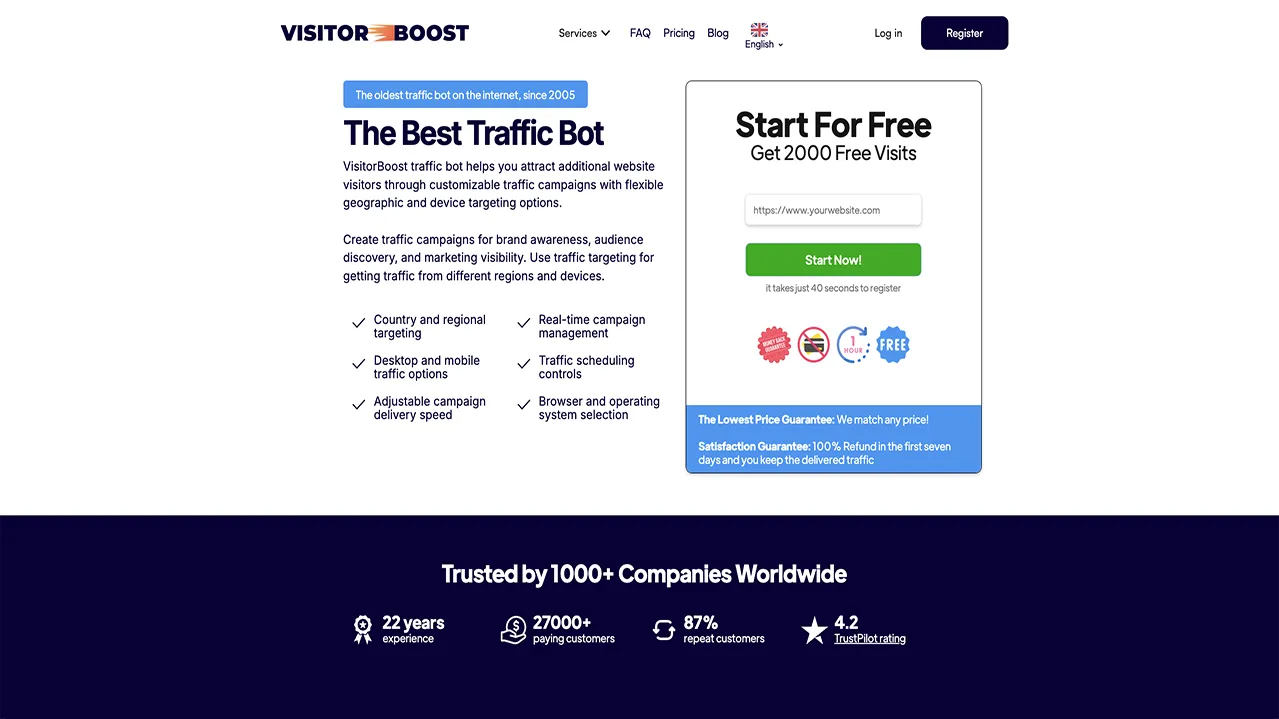
VisitorBoost.com is now the strongest overall placement in this review because it combines an established traffic-bot positioning with a simple onboarding flow, flexible campaign settings, and unusually generous free testing. The website presents VisitorBoost as one of the oldest traffic tools on the internet, with messaging around long-term experience, a large paying customer base, and repeat customer usage. Whether you treat those claims as brand positioning or trust signals, the product is clearly trying to appeal to marketers who want a more dependable website traffic generator rather than a quick, anonymous traffic dump.
The first advantage is accessibility. VisitorBoost advertises a free demo with 2,000 visits and 6,000 page views, and the site says users can start without a credit card. That is a useful way to evaluate whether the traffic appears in analytics, whether the setup feels clear, and whether the delivery pattern matches your expectations before buying a larger package.
The platform also covers the campaign controls that matter most for traffic testing. Users can target countries and regions, choose desktop or mobile visitors, control delivery speed, schedule campaigns, and select browser and operating system options. The FAQ also says campaigns can be configured for session duration, bounce rate, and returning visits. These settings make VisitorBoost more practical than a basic traffic counter because you can shape traffic behavior around a specific testing goal.
Pricing is another reason VisitorBoost deserves a top placement. The site promotes an Economy package starting at $9.96, a free demo option, and higher-tier Expert features from $29.96. It also emphasizes that unused credits do not expire and remain refundable, which is a helpful policy for users who do not want to rush campaign delivery. The “lowest price guarantee” and seven-day satisfaction guarantee add another layer of reassurance, although buyers should still read the current package details before purchasing.
The main limitation is that some claims should be interpreted carefully. VisitorBoost states that the traffic can appear in analytics tools and that the service is not intended for advertising platforms. It also explains that ads may not load during campaign delivery. That is a transparent warning, and it reinforces the broader point: this kind of traffic is best used for controlled testing, visibility experiments, and analytics review, not for misleading advertisers or pretending automated visits are real customer demand.
The first advantage is accessibility. VisitorBoost advertises a free demo with 2,000 visits and 6,000 page views, and the site says users can start without a credit card. That is a useful way to evaluate whether the traffic appears in analytics, whether the setup feels clear, and whether the delivery pattern matches your expectations before buying a larger package.
The platform also covers the campaign controls that matter most for traffic testing. Users can target countries and regions, choose desktop or mobile visitors, control delivery speed, schedule campaigns, and select browser and operating system options. The FAQ also says campaigns can be configured for session duration, bounce rate, and returning visits. These settings make VisitorBoost more practical than a basic traffic counter because you can shape traffic behavior around a specific testing goal.
Pricing is another reason VisitorBoost deserves a top placement. The site promotes an Economy package starting at $9.96, a free demo option, and higher-tier Expert features from $29.96. It also emphasizes that unused credits do not expire and remain refundable, which is a helpful policy for users who do not want to rush campaign delivery. The “lowest price guarantee” and seven-day satisfaction guarantee add another layer of reassurance, although buyers should still read the current package details before purchasing.
The main limitation is that some claims should be interpreted carefully. VisitorBoost states that the traffic can appear in analytics tools and that the service is not intended for advertising platforms. It also explains that ads may not load during campaign delivery. That is a transparent warning, and it reinforces the broader point: this kind of traffic is best used for controlled testing, visibility experiments, and analytics review, not for misleading advertisers or pretending automated visits are real customer demand.
Main features:
- Free demo with 2,000 visits and 6,000 page views
- Country, regional, and city geo-targeting options depending on package
- Desktop and mobile traffic targeting
2. BabylonTraffic.com
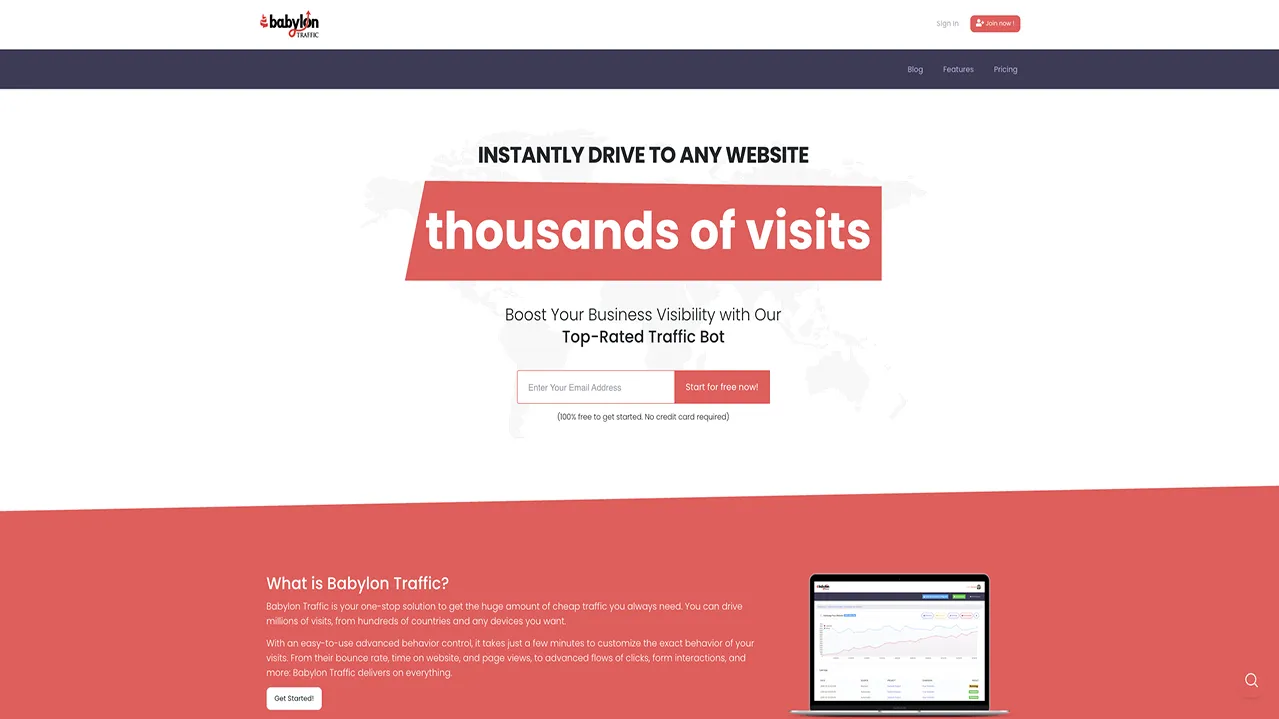
BabylonTraffic.com is a serious competitor because it looks more polished and more feature-rich than many basic traffic bot services. The website positions Babylon Traffic as an online website traffic generator that can send large volumes of geo-targeted automated visits from different countries, devices, and traffic sources. It also places strong emphasis on behavior control, which is useful for users who want more than a simple pageview counter.
The product's main differentiator is its action-based model. Instead of presenting only visits or pageviews, Babylon Traffic explains pricing around “actions,” meaning interactions such as visiting a page, waiting, clicking, or moving through a defined path. This gives users more flexibility when building complex campaigns, although it can also make pricing less intuitive for customers who simply want to compare visit volumes across providers.
Babylon Traffic offers configuration options for bounce rate, time on site, page views, referral sources, keywords, devices, click paths, and even form interactions. It also claims to use real browsers, residential proxies, distributed IP addresses, and behavior simulation. On paper, this makes it one of the more technically detailed services in the market.
Pricing starts at $39 per month for 100 actions per day and rises through classic plans up to $199 per month for 1,000 actions per day. Premium plans extend from $349 to $1,499 per month, with the highest listed plan offering 10,000 actions per day. That range gives Babylon Traffic a broad ladder for scaling, but it also makes the service more expensive than very basic traffic bots.
The free demo is a positive point. Babylon Traffic advertises a 50-visit test without requiring a credit card, which lowers the barrier for new users. The site also lists phone, email, and 24/7 support, which is stronger than many smaller competitors.
At the same time, some of the messaging deserves caution. The website openly describes the service as a generator of “fake traffic,” and the FAQ discusses use cases such as CTR manipulation. Those statements may be transparent, but they also raise practical concerns for users who care about analytics integrity, advertising policies, or long-term SEO strategy. Babylon Traffic is feature-rich, but customers should be clear about what they are testing and avoid using automated traffic in ways that could mislead stakeholders or violate platform rules.
The product's main differentiator is its action-based model. Instead of presenting only visits or pageviews, Babylon Traffic explains pricing around “actions,” meaning interactions such as visiting a page, waiting, clicking, or moving through a defined path. This gives users more flexibility when building complex campaigns, although it can also make pricing less intuitive for customers who simply want to compare visit volumes across providers.
Babylon Traffic offers configuration options for bounce rate, time on site, page views, referral sources, keywords, devices, click paths, and even form interactions. It also claims to use real browsers, residential proxies, distributed IP addresses, and behavior simulation. On paper, this makes it one of the more technically detailed services in the market.
Pricing starts at $39 per month for 100 actions per day and rises through classic plans up to $199 per month for 1,000 actions per day. Premium plans extend from $349 to $1,499 per month, with the highest listed plan offering 10,000 actions per day. That range gives Babylon Traffic a broad ladder for scaling, but it also makes the service more expensive than very basic traffic bots.
The free demo is a positive point. Babylon Traffic advertises a 50-visit test without requiring a credit card, which lowers the barrier for new users. The site also lists phone, email, and 24/7 support, which is stronger than many smaller competitors.
At the same time, some of the messaging deserves caution. The website openly describes the service as a generator of “fake traffic,” and the FAQ discusses use cases such as CTR manipulation. Those statements may be transparent, but they also raise practical concerns for users who care about analytics integrity, advertising policies, or long-term SEO strategy. Babylon Traffic is feature-rich, but customers should be clear about what they are testing and avoid using automated traffic in ways that could mislead stakeholders or violate platform rules.
Main features:
- Advanced behavior controls for bounce rate, time on site, page depth, clicks, and form interactions
- Geo-targeting with residential proxies and custom traffic sources
- Action-based pricing model with classic and premium monthly plans
- Free 50-visit demo without a credit card
- Phone, email, and 24/7 support claims
3. TrafficBot.co
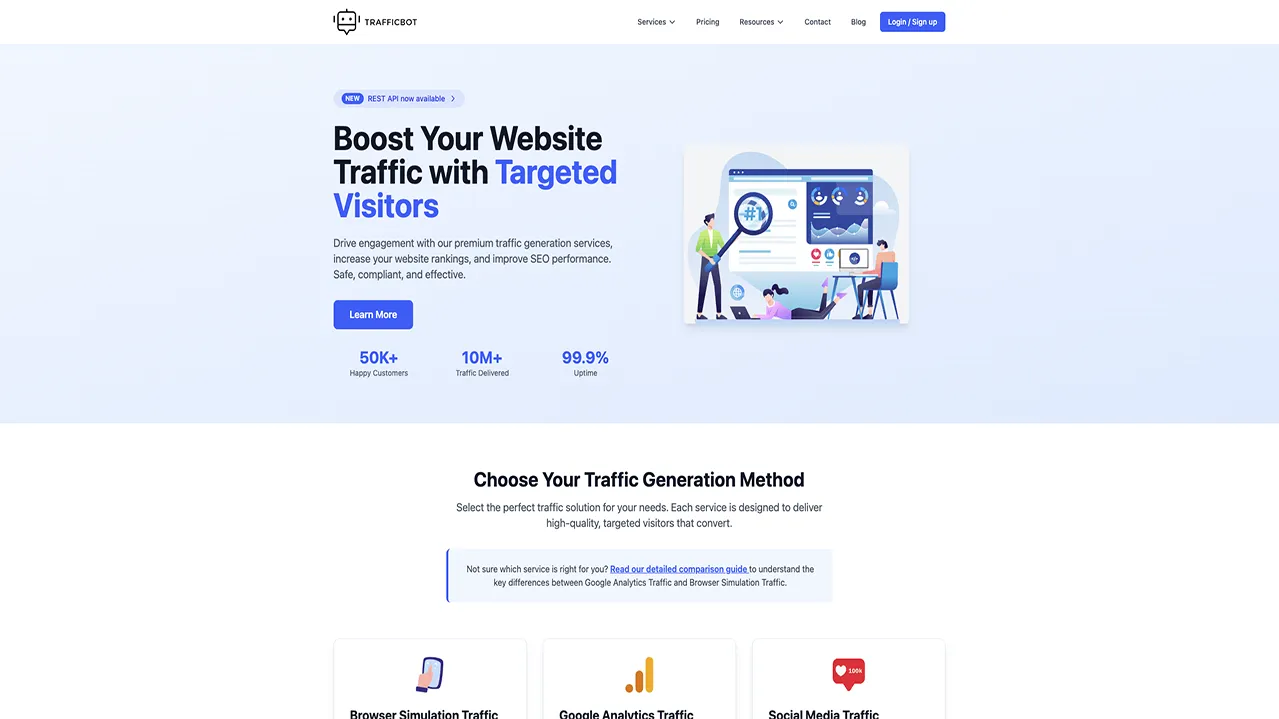
TrafficBot.co appears to be a simpler and older-style traffic bot. We first noticed it several years ago, and the product does not seem to have evolved as much as the stronger competitors in this review. The most visible change is the addition of social media packages, including options connected to platforms such as YouTube and Instagram, but the overall experience still feels limited.
One useful feature is the ability to try a small number of free pageviews without registration. That can help a new visitor understand the basic concept quickly. However, the test experience was not especially reassuring. After requesting free pageviews, the site displayed a short notification that the pageviews were “on the way in the queue,” but there was no detailed report or clear confirmation showing what happened next.
The interface also needs improvement. Some terms and settings, such as “Schedules” and “Child Visit,” were not clear enough for a first-time user. In a category where customers already need to understand traffic quality, sources, and analytics interpretation, unclear language creates unnecessary friction.
Support is another weak point. TrafficBot.co appears to rely heavily on email, and even paid support is described in a limited way. That may be acceptable for a very low-cost experiment, but it is not ideal for users who need dependable delivery, quick troubleshooting, or professional reporting.
The main advantage is price. TrafficBot.co seems cheaper than many alternatives, which may appeal to users who only need a basic test and are comfortable with a less polished interface. For serious or repeated campaigns, however, the limited support and dated user experience make it harder to recommend.
One useful feature is the ability to try a small number of free pageviews without registration. That can help a new visitor understand the basic concept quickly. However, the test experience was not especially reassuring. After requesting free pageviews, the site displayed a short notification that the pageviews were “on the way in the queue,” but there was no detailed report or clear confirmation showing what happened next.
The interface also needs improvement. Some terms and settings, such as “Schedules” and “Child Visit,” were not clear enough for a first-time user. In a category where customers already need to understand traffic quality, sources, and analytics interpretation, unclear language creates unnecessary friction.
Support is another weak point. TrafficBot.co appears to rely heavily on email, and even paid support is described in a limited way. That may be acceptable for a very low-cost experiment, but it is not ideal for users who need dependable delivery, quick troubleshooting, or professional reporting.
The main advantage is price. TrafficBot.co seems cheaper than many alternatives, which may appeal to users who only need a basic test and are comfortable with a less polished interface. For serious or repeated campaigns, however, the limited support and dated user experience make it harder to recommend.
Main features:
- Low-cost traffic bot positioning
- Social media packages for platforms such as YouTube and Instagram
- Small free pageview test without registration
- Simple setup for basic traffic experiments
- Limited support and dated user experience
4. Traffic-Bot.com
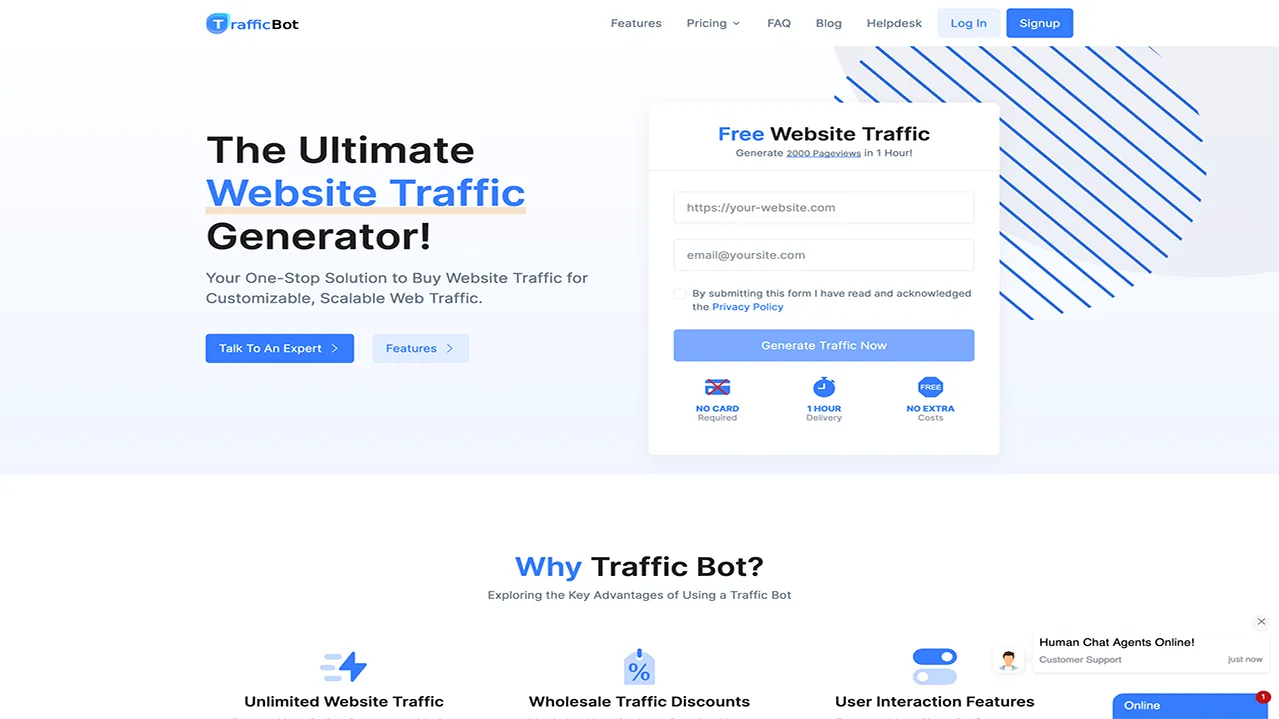
Traffic-Bot.com makes a strong first visual impression. The website design looks modern, and the brand appears to have invested in presentation. The site also includes customer-facing features such as a live chat box and a “Talk To An Expert” option connected to scheduling, which suggests an attempt to make the service feel more accessible.
However, the actual product experience was disappointing during our review. We were unable to complete registration successfully. A welcome email arrived with a discount code, but the login link did not work and did not provide a clear error message. For a traffic bot service, that kind of onboarding issue is a major problem because customers need to trust that campaign setup, payment, and delivery will work reliably.
If the login issue was temporary, Traffic-Bot.com may still provide a usable service. Even so, the publicly visible pricing structure and package presentation appeared similar to many standard traffic-bot offers, without adding obvious new functionality. A polished website is helpful, but it is not enough if the account experience does not work smoothly.
The positive side is the service's effort to be available to customers. Live chat, expert calls, and a modern website can all improve trust when they are backed by a functioning product. The problem is that we could not verify the platform from inside the dashboard at the time of review, so it is difficult to give Traffic-Bot.com a strong rating.
However, the actual product experience was disappointing during our review. We were unable to complete registration successfully. A welcome email arrived with a discount code, but the login link did not work and did not provide a clear error message. For a traffic bot service, that kind of onboarding issue is a major problem because customers need to trust that campaign setup, payment, and delivery will work reliably.
If the login issue was temporary, Traffic-Bot.com may still provide a usable service. Even so, the publicly visible pricing structure and package presentation appeared similar to many standard traffic-bot offers, without adding obvious new functionality. A polished website is helpful, but it is not enough if the account experience does not work smoothly.
The positive side is the service's effort to be available to customers. Live chat, expert calls, and a modern website can all improve trust when they are backed by a functioning product. The problem is that we could not verify the platform from inside the dashboard at the time of review, so it is difficult to give Traffic-Bot.com a strong rating.
Main features:
- Modern-looking website and polished presentation
- Live chat and expert-call options visible on the site
- Welcome email and discount-code onboarding flow
- Product could not be properly tested because login did not work
- No verified standout features at the time of review
5. EpicTrafficBot.com
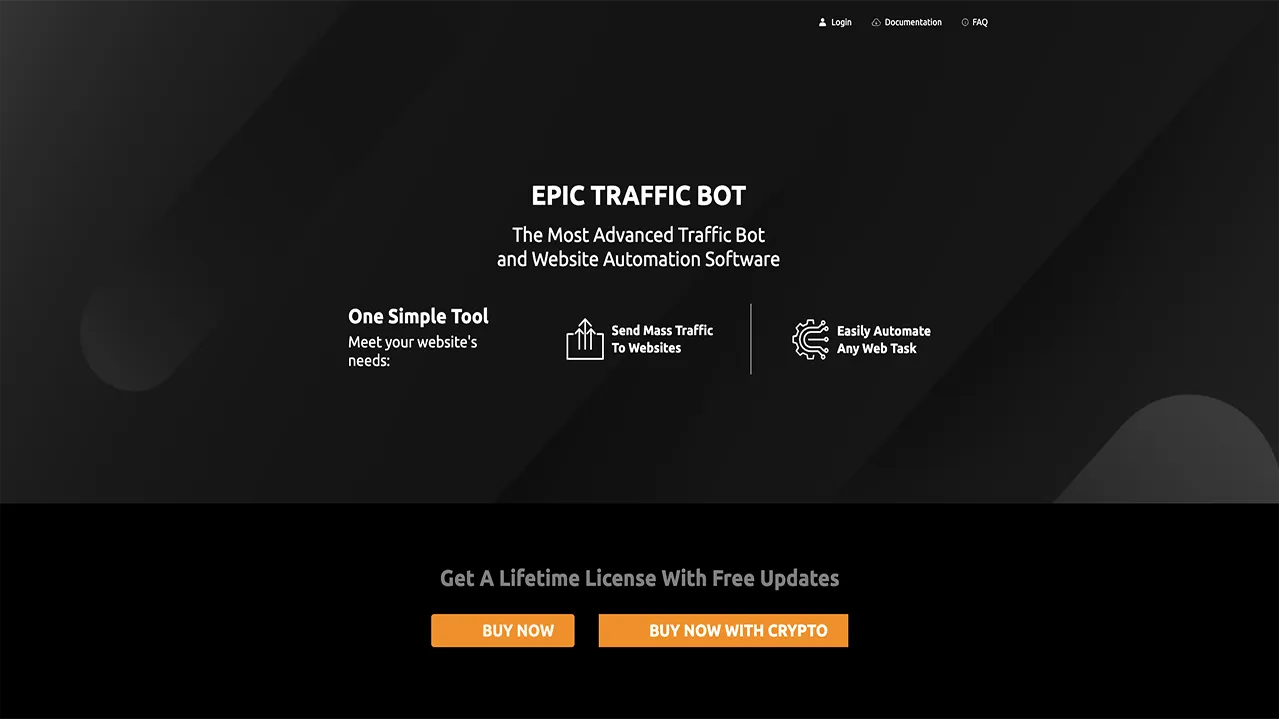
EpicTrafficBot.com is different from the cloud-based services in this comparison because it is downloadable software. Customers pay once and run the tool from their own computer instead of subscribing to a hosted traffic generator. That model can be attractive for users who want independence from a vendor and do not want recurring monthly fees.
The one-time payment model is the main benefit. Once the software is installed, users are not tied to a hosted dashboard or a subscription plan. For technically confident customers, that can feel like more control.
The trade-off is that the user becomes responsible for much more of the traffic setup. You may need your own proxies or rely on low-quality free proxy lists. You also need a compatible Windows environment, a computer that stays online, and enough system resources to keep campaigns running. Those requirements make the product less convenient than a managed cloud-based service.
EpicTrafficBot also appears to place more responsibility on documentation than on direct customer support. Users are expected to understand technical topics, manage configuration details, and solve operational problems themselves. That may work for a technical user who enjoys hands-on control, but it is not ideal for marketers who want a simple website traffic generator they can configure quickly and monitor from anywhere.
The interface is another limitation. Compared with modern SaaS dashboards, downloadable software can feel less intuitive and less flexible. If your priority is convenience, support, and fast setup, EpicTrafficBot is unlikely to be the best fit.
The one-time payment model is the main benefit. Once the software is installed, users are not tied to a hosted dashboard or a subscription plan. For technically confident customers, that can feel like more control.
The trade-off is that the user becomes responsible for much more of the traffic setup. You may need your own proxies or rely on low-quality free proxy lists. You also need a compatible Windows environment, a computer that stays online, and enough system resources to keep campaigns running. Those requirements make the product less convenient than a managed cloud-based service.
EpicTrafficBot also appears to place more responsibility on documentation than on direct customer support. Users are expected to understand technical topics, manage configuration details, and solve operational problems themselves. That may work for a technical user who enjoys hands-on control, but it is not ideal for marketers who want a simple website traffic generator they can configure quickly and monitor from anywhere.
The interface is another limitation. Compared with modern SaaS dashboards, downloadable software can feel less intuitive and less flexible. If your priority is convenience, support, and fast setup, EpicTrafficBot is unlikely to be the best fit.
Main features:
- Downloadable traffic bot software
- One-time payment model instead of a monthly subscription
- More independence from the vendor after purchase
- Requires proxies, a compatible Windows setup, and an always-on computer
- Better suited to technical users than busy marketers
Final Verdict: Which Traffic Bot Should You Choose?
If you need the best overall balance of accessibility, pricing, campaign controls, and low-risk testing, VisitorBoost.com is the strongest choice in this comparison. It offers a free 2,000-visit demo, flexible geo and device targeting, adjustable campaign settings, refundable unused credits, and a simple positioning that makes it approachable for marketers who want a practical website traffic generator.
BabylonTraffic.com is the most feature-heavy alternative. It has a polished presentation, detailed behavior controls, geo-targeting, an action-based pricing model, and a free 50-visit demo. It is a credible option for users who want advanced configuration, but its messaging around fake traffic and CTR manipulation means customers should use it carefully and transparently.
TrafficBot.co may appeal to users looking for a low-cost basic test, but the dated interface and limited support make it less convincing for regular use. Traffic-Bot.com looks promising from the outside, but the failed login experience prevented a proper review. EpicTrafficBot.com is best understood as a technical, self-managed option for users who specifically want downloadable software and are comfortable handling proxies and local setup themselves.
The right traffic bot depends on your purpose. If you are testing analytics, benchmarking infrastructure, or running controlled internal experiments, choose a provider with clear settings, reliable delivery, and responsive support. If your goal is real business growth, remember that automated traffic should only support your broader strategy. Sustainable performance still comes from useful content, trustworthy marketing, technical quality, and real people choosing to visit, stay, and convert.
BabylonTraffic.com is the most feature-heavy alternative. It has a polished presentation, detailed behavior controls, geo-targeting, an action-based pricing model, and a free 50-visit demo. It is a credible option for users who want advanced configuration, but its messaging around fake traffic and CTR manipulation means customers should use it carefully and transparently.
TrafficBot.co may appeal to users looking for a low-cost basic test, but the dated interface and limited support make it less convincing for regular use. Traffic-Bot.com looks promising from the outside, but the failed login experience prevented a proper review. EpicTrafficBot.com is best understood as a technical, self-managed option for users who specifically want downloadable software and are comfortable handling proxies and local setup themselves.
The right traffic bot depends on your purpose. If you are testing analytics, benchmarking infrastructure, or running controlled internal experiments, choose a provider with clear settings, reliable delivery, and responsive support. If your goal is real business growth, remember that automated traffic should only support your broader strategy. Sustainable performance still comes from useful content, trustworthy marketing, technical quality, and real people choosing to visit, stay, and convert.