

How to Get Real Buyer Traffic to Your Website
More than half of all web traffic is generated by bots, according to Wikipedia's article on internet bots. Add the people who arrive by accident or only to read, and a report with thousands of sessions can hide a very small number of buyers. Most lists of ways to increase website traffic count visits, while your revenue depends on the few visits that arrive with a purchase in mind.
This guide explains how to get real buyer traffic: visitors who have a problem your offer solves and a reason to act now. We move from the difference between buyer and browsing traffic to intent matching, channels, landing pages, measurement and the shortcuts that waste budget. One principle stays the same in every section: search engines and ad platforms deliver the visit, but a real person decides whether to buy.
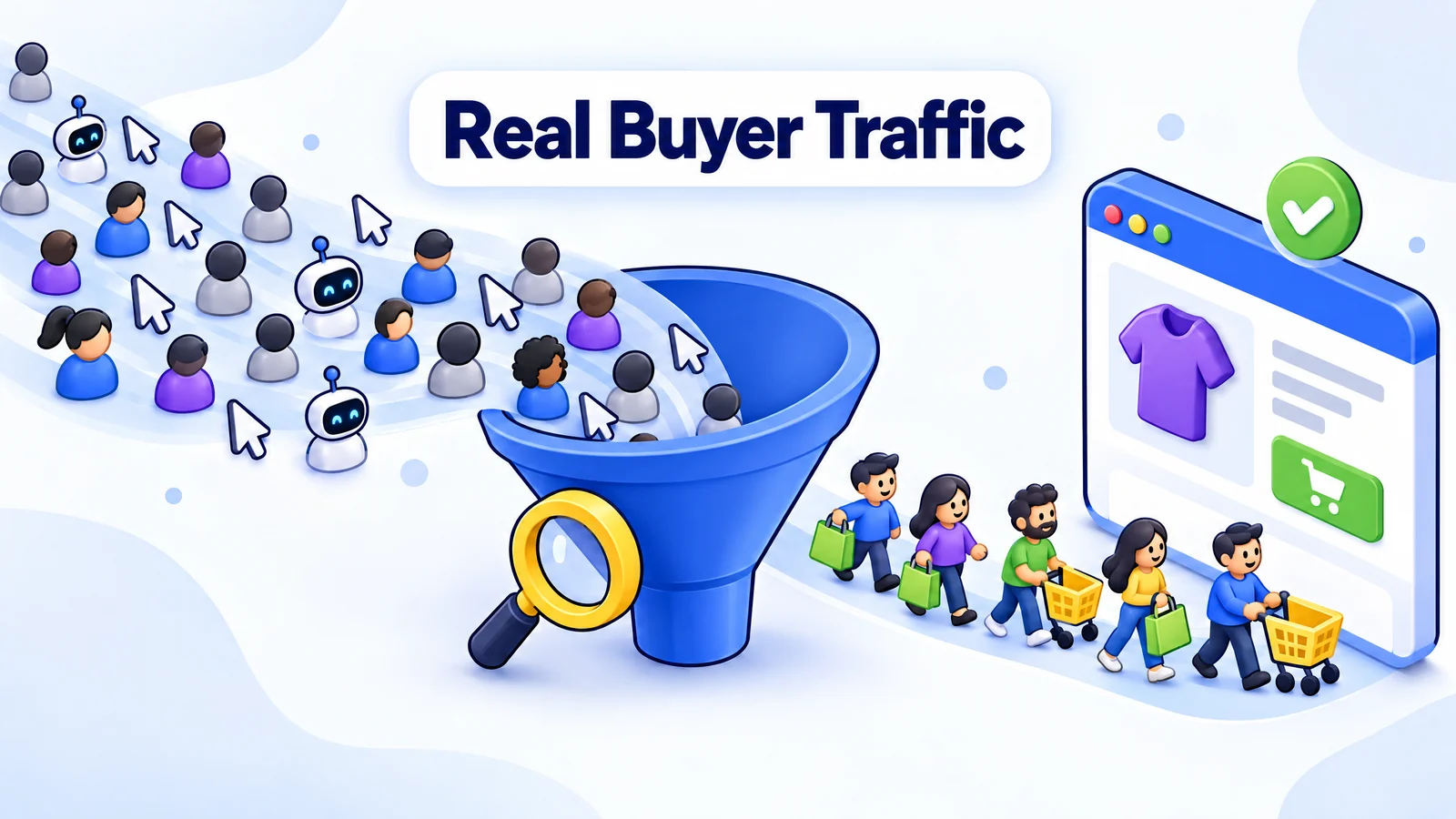
Buyer Traffic vs Browsing Traffic
Two websites can report the same 10,000 sessions in a month and earn very different amounts. The first site gets most of its visits from a viral article about industry trends. The second gets fewer readers per page, but its visitors arrive from searches such as "accounting software for freelancers price". Only the second site has a steady flow of buyers.
The difference is intent. Wikipedia's article on web search queries describes three broad categories: informational, navigational and transactional. Transactional queries are the ones that "reflect the intent of the user to perform a particular action, like purchasing a car". Buyer traffic is the share of your visits that comes from this kind of intent, whatever the channel.
The metric that shows the difference is the conversion rate. Wikipedia defines it as "the percentage of visitors who complete a goal, as set by the site owner" (Wikipedia: Conversion rate optimization). A site with 200 visitors and 30 newsletter sign-ups in a day has a conversion rate of 15% for that day. Browsing traffic raises the visitor count and lowers this rate, while buyer traffic raises both sales and the rate.
How to Sort Your Current Traffic by Intent
You can measure your buyer share with data you already have. In Google Search Console, the Performance report lists the queries that bring visitors to each page. Each query fits one of three labels: "know" for research, "go" for brand or navigation, and "do" for a clear action such as buying, booking or requesting a quote.
The next step is to compare conversion rates by label in GA4, using the landing pages that each query group reaches. In most accounts the "do" pages convert at a much higher rate than the "know" pages. This split tells you which pages deserve more traffic and which pages need a clearer path to an offer, and it gives every later decision in this guide a baseline.
Matching Intent: Keyword, Country and Device
A visitor can have buying intent and still be the wrong buyer for you. A plumbing company in Leeds gains nothing from a visit by a homeowner in Sydney, even if the query was "emergency plumber price". A SaaS product with a desktop-only sign-up flow loses most mobile visitors at the first form. Intent brings people to the door, and the match decides whether they can walk through it.
Location plays a larger role than many marketers expect. A study of Excite search logs, cited in Wikipedia's article on web search queries, found that 19% of queries contained a geographic term such as a place name or zip code. People often tell the search engine where they want to buy, and pages that ignore location miss that signal.

Keyword Match
Buyer keywords usually carry a modifier: "price", "cost", "buy", "near me", "for small business" or a product model. These modifiers show that the searcher has moved past research. A page that targets "project management software" competes for readers, while a page that targets "project management software for architects pricing" competes for buyers.
The practical rule is one buyer query family per page. When a page answers one specific "do" query with the price, the offer and the next step, the visitor has no reason to search again. That relevance is also what search engines reward, so the same choice helps rankings and conversions.
Country and Device Match
Country and device decide whether a buyer can actually use your offer. Shipping zones, currencies, languages and opening hours all depend on location, and form length and page speed matter more on mobile. A page that shows prices in the visitor's currency and works on the visitor's device removes two common reasons to leave.
If you wonder how to get targeted traffic to your website, paid channels give the most direct answer. They make this match explicit through geo-targeting by country, region or city, and through device settings. Organic search builds it through local content, language versions and clear location details on the page. In both cases, the match works because it narrows the audience to people who can complete the purchase.
Targeted Paid Traffic for Testing the Match
Targeted traffic means visits filtered by location, device or interest before they reach your site. Before you spend an ad budget on a country or device, it helps to know that the page works for that audience. This is where we see many teams lose money: the campaign starts, and only then do they notice a broken mobile layout or a GA4 event that never fires for visitors from one country.
VisitorBoost is a website traffic platform, and its targeted website traffic service sends visits filtered by country, city, niche and device to the pages you choose. You can watch those visits arrive in GA4 or another analytics tool and confirm that the page loads, displays and records events correctly for the audience profile you plan to pay for. These visits are a test of the match, not a replacement for buyers, and a free trial of 2,000 visits lets you run that test before any spending decision.
Channels That Bring Buyers
The question of how to get customers to your website is mostly a question of channels. Every channel can bring visitors, but channels differ in the intent they carry. A social post can reach 50,000 people and produce two sales, because most viewers were scrolling for entertainment. A search result for a "do" query reaches far fewer people, and many of them arrive ready to compare offers and buy.
Search is the largest source of intent for most businesses. Google holds around 90% of the global search market, according to Wikipedia's article on Google Search, so organic rankings and paid search ads for transactional queries usually form the core of buyer traffic. Email to existing subscribers, referrals from partners, review sites and marketplaces follow, because their visitors already know the product category.
Online stores have their own channel mix, with shopping ads, marketplace listings and product comparison sites, so traffic for online stores deserves a separate plan. Service businesses depend more on local search, maps listings and referrals. B2B companies often get their best buyers from comparison searches, webinars and email follow-ups after a demo request.
How to Rank Channels by Buyer Value
A simple score shows where to invest: conversions per channel divided by the cost or time each channel requires. A channel with 300 visits and 12 sales outperforms a channel with 5,000 visits and 10 sales, even though the second looks better in a traffic report. The score keeps the focus on buyers instead of visit counts.
This method works because it uses your own results instead of industry averages. It also shows when a low-volume channel deserves more effort. A partner referral that sends 40 visits and 6 customers a month is often the cheapest buyer source you have.
Landing Page Fit: Turning Buyer Visits Into Customers
Buyer traffic can still fail on arrival. A visitor clicks an ad for "same-day delivery in Madrid" and lands on a general homepage with no delivery information. The intent was right and the channel was right, but the page broke the promise, and the visitor goes back to the search results.
Wikipedia describes a landing page as a page that "will usually display directed sales copy that is a logical extension of the advertisement, search result or link" (Wikipedia: Landing page). The same article notes that the actions visitors take on the landing page "are what determine an advertiser's conversion rate". In other words, the page is the point where buyer traffic turns into revenue or into wasted spend.
A Five-Point Landing Page Check
- Message match: the headline repeats the promise of the ad, search result or link.
- Price and terms: the visitor finds the price, delivery or contract terms without searching.
- One clear action: the page has one main button or form, and it fits the visitor's stage.
- Speed: the page loads fast on mobile, because buyers on slow pages leave before they read.
- Trust: real reviews, guarantees, contact details and clear refund rules sit near the action.
Each point removes one reason to leave. Buyers arrive with a question, such as price, fit or risk, and a page that answers the question in seconds keeps them moving. This is also the human-first test: if a real customer can decide on the page without asking anyone, the page is ready for more traffic.
Measuring Buyers in GA4
A traffic report that shows only sessions cannot tell you whether you got more buyers. A month with 40% more sessions looks like progress until revenue stays flat. Without campaign labels and key events, every channel looks the same in the data, and budget decisions turn into guesses.
UTM parameters solve the labelling part. Wikipedia describes them as "five variants of URL parameters used by marketers to track the effectiveness of online marketing campaigns across traffic sources and publishing media" (Wikipedia: UTM parameters). A link with utm_source, utm_medium and utm_campaign tells GA4 exactly which email, ad or partner sent each visitor.
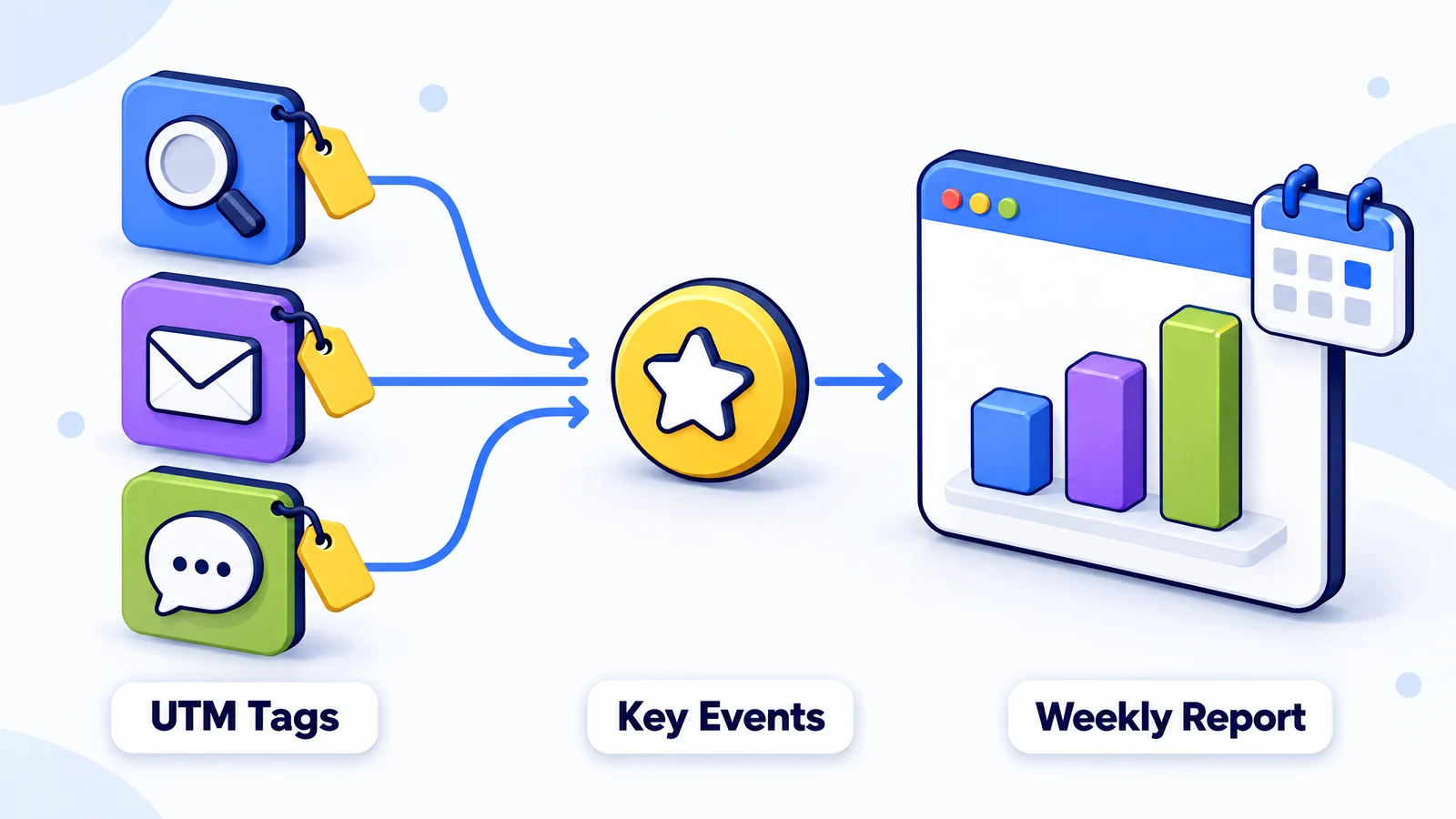
Key events cover the second part. In GA4, a key event is an action you mark as important, such as a purchase, a demo request or a sign-up. When every buyer action is a key event, the Traffic acquisition report shows the key event rate for each source and medium, and that rate is your buyer traffic score per channel.
A Weekly Buyer Traffic Report
Four numbers are enough for a weekly review:
- Key events per channel, from the Traffic acquisition report.
- Key event rate per landing page, to find pages that attract buyers but fail to convert them.
- Revenue or lead value per session, to compare channels with different volumes.
- The share of sessions from "do" queries in Search Console, to track your buyer share over time.
This short report works because it keeps attention on outcomes. A channel that grows sessions but not key events gets a closer look before it gets more budget. A page with a high buyer share and a low key event rate goes to the top of the landing page fixes.
Shortcuts That Bring the Wrong Visitors
Pressure for fast growth pushes many teams to chase volume. Cheap bulk visits make a dashboard look busy, keyword-stuffed pages try to rank for every variation at once, and clickbait headlines lift click rates. Each shortcut adds visitors who were never going to buy.
These tactics are counterproductive, and the damage goes beyond risk. Fake or untargeted sessions lower your conversion rate and hide real problems on the page. Ad platforms that optimize bids on conversion data learn from your results, so a flood of the wrong visitors teaches them the wrong audience. Search engines today rank pages by how well they answer the query, so the old habit of repeating a keyword fifty times works against you.
Some industries face higher standards. Finance, health and legal businesses deal with topics where Google applies stricter quality expectations, and regulators set rules for claims and advertising. In these fields, transparent pricing, real credentials and accurate claims matter even more, because buyers check them before they act.
How to Keep Test Traffic Separate
Any traffic you send for testing deserves its own label. A dedicated utm_campaign value, such as utm_campaign=page-test-november, lets you exclude the test from business reports with one comparison. A separate GA4 property works even better for larger tests.
This separation protects the buyer data that every decision in this guide depends on. Clean data shows which channels and pages bring customers. Mixed data hides them, and the cost of untangling it later is far higher than the minute it takes to add a label.
Conclusion: Buyers First, Volume Second
Real buyer traffic comes from a chain of matches: the query shows intent, the country and device fit the offer, the channel carries the right audience and the landing page keeps the promise. When one link in that chain breaks, more visits only add cost.
The approach we follow at VisitorBoost is simple: test the match, then grow with real people. Buyers are measured by key events instead of sessions, budget goes to the channels with the best buyer value, and every test carries a label. Your website then grows in the number that matters most: customers.