
← Back to the Blog
Apr 4, 2026 · 9 min read
Daniel Igwe
VisitorBoost team
5 Best Ways To Use Website Traffic Generator
In the digital ecosystem of 2026, driving a consistent, scalable stream of visitors to your website is the cornerstone of online business success. However, as search engines integrate generative artificial intelligence (AI) and consumer behavior shifts toward self-education, traditional traffic acquisition methods have become increasingly slow and competitive. To stand out, modern digital marketers must combine foundational web optimization with advanced, high-velocity traffic solutions.
Among these modern solutions, sophisticated website traffic generators have emerged as indispensable, high-impact practices. Far from being a mere shortcut, using an advanced traffic generator is now recognized as a highly strategic method to seed initial site data, accelerate search visibility, and power rapid conversion optimization. Below is a detailed, professional analysis of the five best practices for generating website traffic, highlighting how traffic generators can be seamlessly integrated to supercharge your digital marketing results.
Among these modern solutions, sophisticated website traffic generators have emerged as indispensable, high-impact practices. Far from being a mere shortcut, using an advanced traffic generator is now recognized as a highly strategic method to seed initial site data, accelerate search visibility, and power rapid conversion optimization. Below is a detailed, professional analysis of the five best practices for generating website traffic, highlighting how traffic generators can be seamlessly integrated to supercharge your digital marketing results.
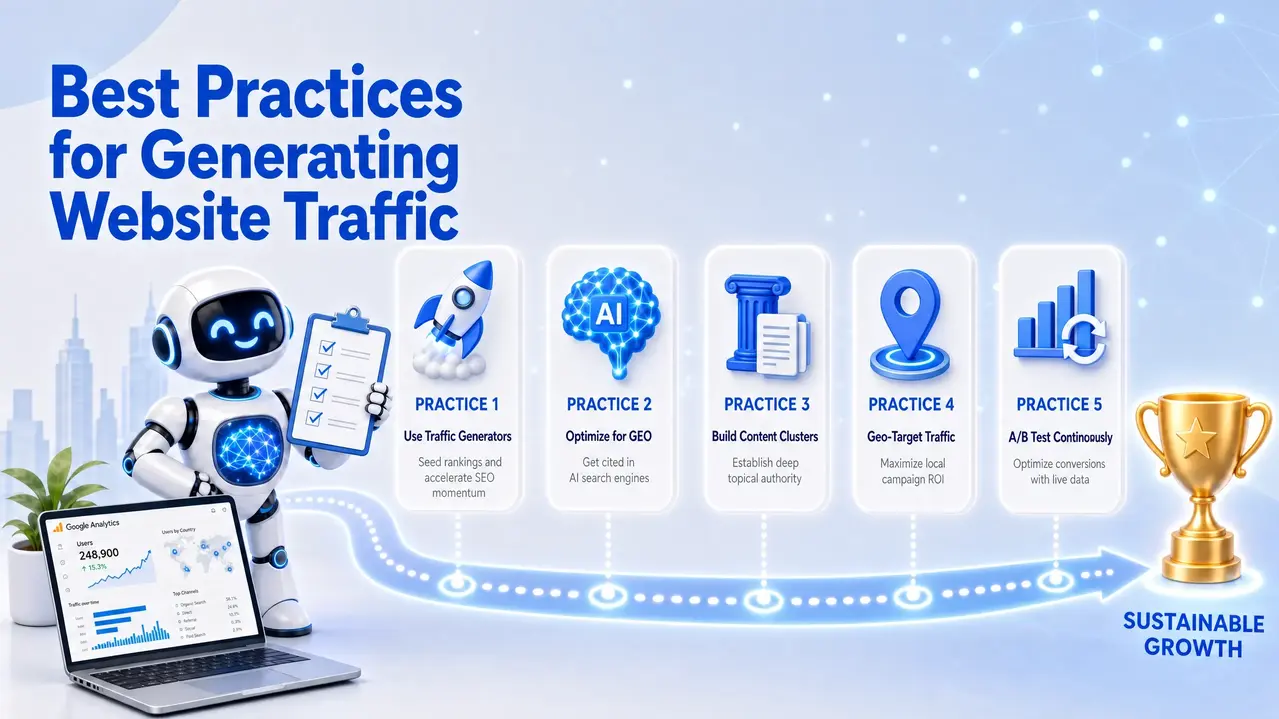
Traffic Generation Best Practices at a Glance
The table below outlines the five core traffic-generation practices, their primary mechanisms, and how incorporating a website traffic generator enhances the effectiveness of each strategy.
Traffic Generation Practice
Core Mechanism
Role of Traffic Generators
Key Metric Boosted
1. Advanced Traffic Generators
Automated high-quality behavioral routing
Seeds ranking signals and accelerates testing
Click-Through Rate (CTR) & Dwell Time
2. Generative Engine Optimization
Optimizing for AI search and conversational engines
Drives behavioral validation for AI citations
AI Share of Voice & Mentions
3. High-Impact Content Clusters
Creating problem-solving, structured content
Directs initial traffic to validate content clusters
Pages per Session & Dwell Time
4. Localized Geo-Targeting
Delivering location-specific campaigns
Routes highly targeted local proxy traffic
Local Conversion Rate & Regional ROI
5. Continuous A/B Testing
Optimizing landing pages for user experience
Supplies instant, predictable visitor volume
Funnel Conversion Rate
1. Integrating Advanced Website Traffic Generators as a Core Catalyst
The foremost best practice in a modern traffic acquisition strategy is the integration of advanced website traffic generators. In the past, websites relied solely on slow, passive organic growth that could take months to yield results. Today, sophisticated AI-powered traffic generators act as powerful accelerators, providing the initial momentum that new and growing websites desperately need.
By using a high-quality traffic generator, marketers can inject a steady, controlled stream of engaged visitors to specific high-value pages. This rapid influx of traffic simulates natural human browsing behaviors, such as multi-page navigation and healthy dwell times, which sends highly positive signals to search engine algorithms. These behavioral signals indicate to search engines that your website is active and relevant, which, in turn, accelerates your organic indexing and boosts your keyword rankings on search engine results pages (SERPs).
By using a high-quality traffic generator, marketers can inject a steady, controlled stream of engaged visitors to specific high-value pages. This rapid influx of traffic simulates natural human browsing behaviors, such as multi-page navigation and healthy dwell times, which sends highly positive signals to search engine algorithms. These behavioral signals indicate to search engines that your website is active and relevant, which, in turn, accelerates your organic indexing and boosts your keyword rankings on search engine results pages (SERPs).
2. Optimizing for Generative Engine Optimization (GEO)
2. Optimizing for Generative Engine Optimization (GEO)With the explosive rise of generative AI platforms like ChatGPT, Perplexity, and Google's AI Overviews, search has evolved far beyond traditional blue links. Marketers must now implement Generative Engine Optimization (GEO) to ensure their brand is cited and recommended in conversational AI responses. GEO focuses on structuring content with extreme clarity, authority, and context so that large language models (LLMs) can easily crawl and extract it.
Website traffic generators play a vital, complementary role in a successful GEO strategy. AI search engines prioritize brands that demonstrate high user engagement and authority across the web. By driving consistent, targeted traffic to your AI-optimized pages, traffic generators help validate your content's relevance. This increased behavioral validation signals to AI crawlers that your site is a trusted source of information, dramatically increasing the likelihood that your brand will be featured as a primary citation in AI-generated answers.
Website traffic generators play a vital, complementary role in a successful GEO strategy. AI search engines prioritize brands that demonstrate high user engagement and authority across the web. By driving consistent, targeted traffic to your AI-optimized pages, traffic generators help validate your content's relevance. This increased behavioral validation signals to AI crawlers that your site is a trusted source of information, dramatically increasing the likelihood that your brand will be featured as a primary citation in AI-generated answers.
3. Developing High-Impact, Problem-Solving Content Clusters
Content remains the lifeblood of web traffic, but in 2026, publishing disjointed articles is no longer effective. The industry best practice is to build comprehensive "topic clusters" around central "pillar pages". This structure signals deep topical authority to search engines while providing a seamless, highly navigable resource for users seeking solutions to specific problems.
To maximize the ROI of your content clusters, website traffic generators can be used to direct targeted visitors directly to your core pillar pages. Instead of waiting months for search engines to discover your new content hub, a traffic generator ensures your high-value resources receive immediate visibility. As these visitors naturally navigate from your pillar pages to related subtopic articles, they reduce your site's bounce rate and increase pages-per-session metrics, further cementing your site's authority in the eyes of search algorithms.
To maximize the ROI of your content clusters, website traffic generators can be used to direct targeted visitors directly to your core pillar pages. Instead of waiting months for search engines to discover your new content hub, a traffic generator ensures your high-value resources receive immediate visibility. As these visitors naturally navigate from your pillar pages to related subtopic articles, they reduce your site's bounce rate and increase pages-per-session metrics, further cementing your site's authority in the eyes of search algorithms.
4. Leveraging Localized Geo-Targeting for Maximum Relevance
In digital marketing, relevance is directly tied to location. Over 46% of all Google searches have local intent, and consumers increasingly expect digital experiences to be tailored to their physical location. Therefore, implementing a strict geo-targeting strategy across your landing pages and traffic campaigns is an absolute necessity.
Advanced website traffic generators excel in this area by offering precise, geo-targeted routing. Rather than driving generic, low-value global traffic, these tools allow you to target visitors from specific countries, states, cities, or even ZIP codes. This localized traffic is highly relevant to regional campaigns, ensuring that your localized landing pages receive visitors who actually match your business's geographic service areas. This micro-targeting eliminates wasted marketing resources, lowers your cost-per-acquisition, and drives a significantly higher return on investment (ROI).
Advanced website traffic generators excel in this area by offering precise, geo-targeted routing. Rather than driving generic, low-value global traffic, these tools allow you to target visitors from specific countries, states, cities, or even ZIP codes. This localized traffic is highly relevant to regional campaigns, ensuring that your localized landing pages receive visitors who actually match your business's geographic service areas. This micro-targeting eliminates wasted marketing resources, lowers your cost-per-acquisition, and drives a significantly higher return on investment (ROI).
5. Conducting Continuous, High-Velocity A/B Testing
A high volume of website traffic is only valuable if it converts into leads, subscribers, or customers. To ensure your website is a high-performing conversion machine, digital marketers must engage in continuous, data-driven A/B testing of headlines, call-to-action (CTA) buttons, layouts, and forms.
However, traditional A/B testing requires a massive volume of visitors to achieve statistical significance, a luxury that new or low-traffic websites do not have. Website traffic generators solve this challenge by providing a predictable, immediate volume of targeted visitors to your test pages. This allows webmasters to run complex conversion rate optimization (CRO) experiments in a fraction of the time, letting you rapidly optimize your user experience and secure a highly efficient conversion funnel before scaling up expensive paid advertising campaigns.
However, traditional A/B testing requires a massive volume of visitors to achieve statistical significance, a luxury that new or low-traffic websites do not have. Website traffic generators solve this challenge by providing a predictable, immediate volume of targeted visitors to your test pages. This allows webmasters to run complex conversion rate optimization (CRO) experiments in a fraction of the time, letting you rapidly optimize your user experience and secure a highly efficient conversion funnel before scaling up expensive paid advertising campaigns.
Conclusion
Generating website traffic in today's competitive digital landscape requires a strategic blend of technical optimization and high-velocity acceleration. By implementing these five best practices anchored by the powerful, strategic use of advanced website traffic generators, businesses can bypass the slow, passive growth phases of the past. When integrated alongside GEO, structured content clusters, localized targeting, and rigorous A/B testing, website traffic generators serve as an indispensable asset that drives rapid search engine momentum, establishes immediate brand authority, and unlocks sustainable, long-term business growth.